Early Failure Detection and Intervention
in Video Diffusion Models

1 Pohang University of Science and Technology (POSTECH)2 Korea Advanced Institute of Science and Technology (KAIST)

NeurIPS 2026

Video quality metrics saturate early

Latent-to-RGB (L2R) preview

“A corgi is playing drum kit.”

By step 10, the preview depicts a human drummer rather than the requested corgi.

Early saturation of video quality metrics Wan2.1-1.3B: normalized errors between intermediate and final video quality metrics fall sharply during early denoising. Curves are averages over 1,800 prompts, not scores for the example preview. The dashed guide follows the selected denoising step. Wan2.1-1.3B Error vs. final video
  • Overall Consistency
  • Aesthetic Quality
  • Background Consistency
  • Subject Consistency
  • Imaging Quality

1,800-prompt mean · normalized error

10 / 50

Drag left or right to explore

Detect early, intervene selectively

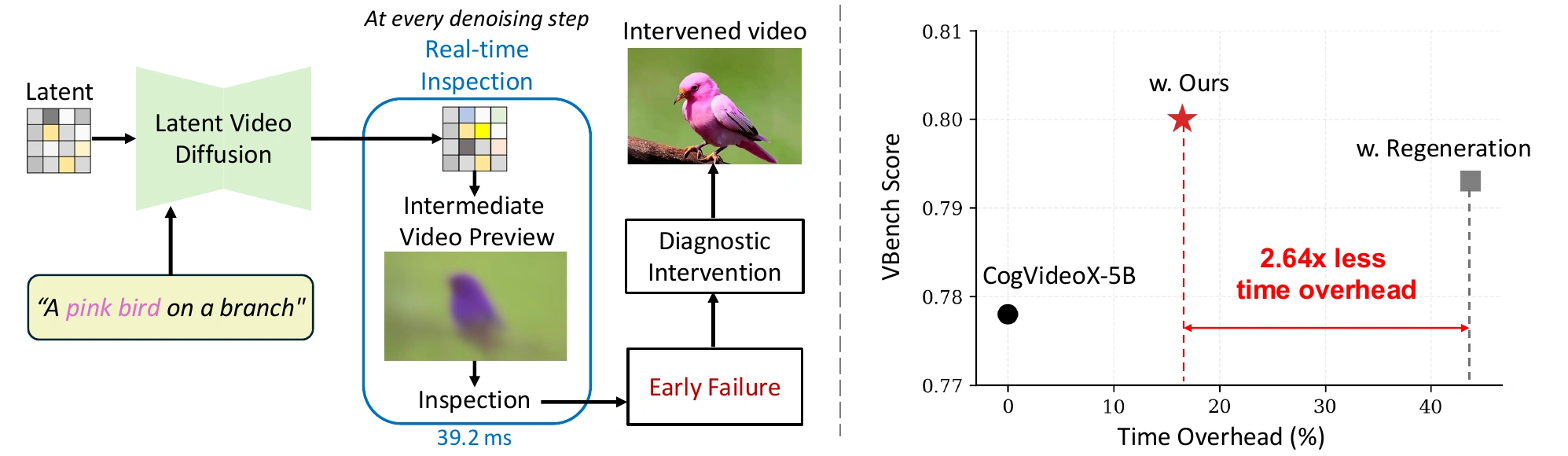
Waiting for a full video that misses the user's intent wastes both compute and time. We inspect early previews to catch likely failures, diagnose the mismatch, and intervene selectively. A lightweight single-frame probe guides semantic injection; visual feedback refines the prompt when needed. The aim is to reach a satisfactory video sooner, with less wasted generation.

Paper Figure 1: real-time inspection detects a failing bird generation from an intermediate preview, then diagnostic intervention corrects it. On CogVideoX-5B, ours improves the VBench final score from 0.778 to 0.800 with 16.55% extra time, compared with 0.793 and 43.73% for regeneration.

Latent-to-RGB (L2R) module enables early failure detection with negligible resource overhead

A tiny L2R module delivers previews ≈203× faster than the original CogVideoX decoder.

19.7 mspreview latency
0.059Mtrainable parameters
0.286 MBL2R checkpoint (FP32)

58,995 parameters · 0.286 MB L2R checkpoint for both CogVideoX and Wan.

“Iron Man flying in the sky” CogVideoX-5B
Denoising step
Schematic of the shared predicted clean latent tensor
Shared latentStep 10 / 50Schematic

L2R (ours)

19.7 ms
Choose a step to decode

Original decoder

3.990 s
Choose a step to decode

Recorded previews replay the paper’s decoder latencies after loading. This is a timing illustration, not live model inference.
VBench results

Original-prompt VBench scores and additional generation time for four methods on two video diffusion models.
MethodCogVideoX-5BWan2.1-1.3B
Final ↑Quality ↑Semantic ↑Time
overhead ↓
Final ↑Quality ↑Semantic ↑Time
overhead ↓
Original model (No intervention)0.7780.8030.6800.00%0.7890.8110.7000.00%
+ Regeneration0.7930.8130.71643.73%0.8150.8230.78351.25%
+ Ours0.8000.8160.73516.55%0.8050.8170.75620.30%
w/ Qwen3.8-27B (VLM)0.7910.8120.70616.49%0.8020.8200.73220.08%

Bold scores: best VBench result. GPT-5-mini is the default VLM; we also evaluated Qwen3.8-27B as an alternative.

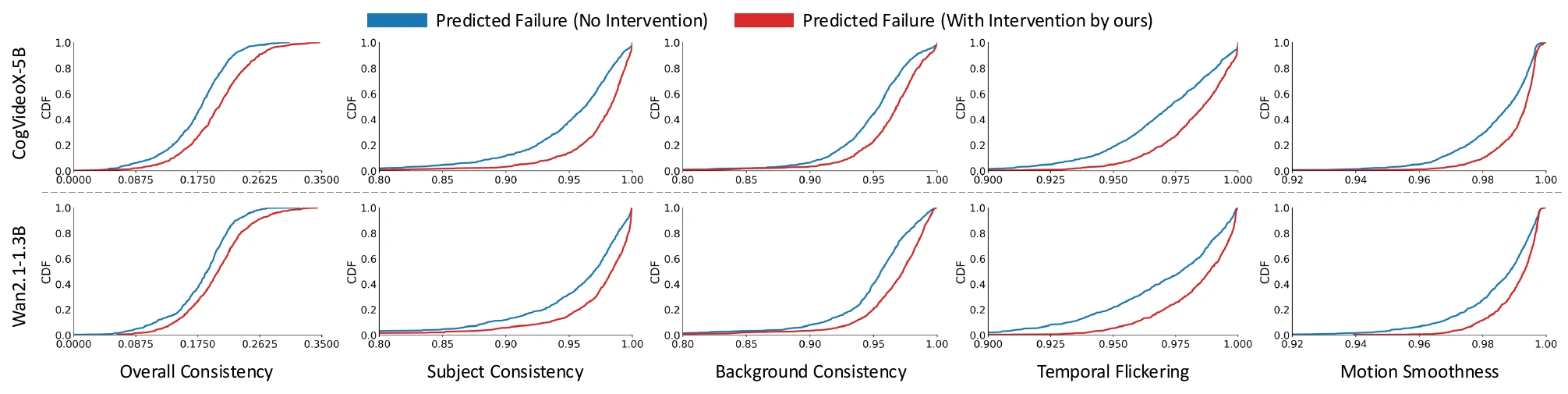
VBench on detected failures

VBench + Panda70M · 872 CogVideoX / 811 Wan failures

VBench metric distributions on predicted failures: intervention shifts Overall Consistency, Subject Consistency, Background Consistency, Temporal Flickering and Motion Smoothness toward higher scores on both models.

Qualitative results

“A corgi is playing drum kit.”

Wan2.1-1.3B
Without intervention
With our intervention

More qualitative results

Future work

We aim to detect finer-grained failures earlier and develop more efficient, effective interventions. More expressive yet lightweight video evaluators could help identify subtle motion artifacts and compositional errors, reducing wasted generation compute for service providers and shortening the time to satisfactory videos for users.

BibTeX

@article{kwon2026earlyfailure,
  title   = {Early Failure Detection and Intervention in Video Diffusion Models},
  author  = {Kwon, Byungki and Lim, Sohwi and Nam, Hyeon-Woo
             and Moon, Ye-Bin and Oh, Tae-Hyun},
  journal = {arXiv preprint arXiv:2603.14320},
  year    = {2026}
}